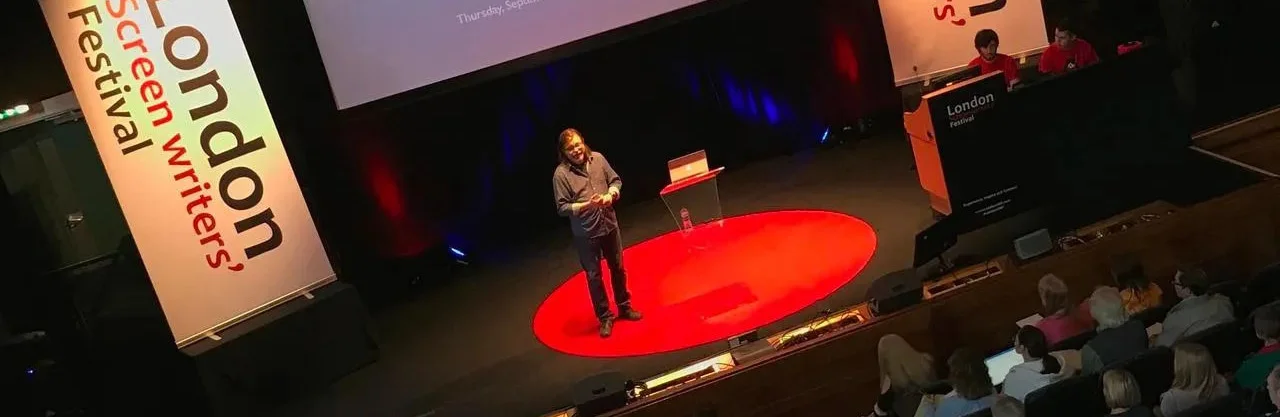
The Narrative Imperative with Scott Myers
🎬 On demand — watch any time · £47
£47lifetime access
Pre-recorded — start watching as soon as you’re in.
🎬 On demand — watch any time · £47
£47lifetime access
Pre-recorded — start watching as soon as you’re in.
★★★★★Read all reviews
“Scott Myers is a guru of insight into how stories and scripts are put together. He is one of the greats”
 Sarah Frankland (Script Reader)★★★★★
Exploring Your Protagonist's Psychological Journey.
Why is the Protagonist the most critical character in your story-crafting process? How can you use their experience in the story, their deep psychology and their past to ramp up the stakes and move your script from 'pretty good' to un-put-downable?

Screenwriter (K-9, Alaska, Trojan War), professor (DePaul University School of Cinematic Arts), and host of GoIntoTheStory.com, the official screenwriting blog of the Black List.
On demand with immediate access, start right now
Six hours of training
Four hours bonus seminars
One year access
Every event that happens, every character who emerges is tied to the Protagonist and their unique psychological journey.

Learn how you can delve into your Protagonist to craft your story’s structure in this masterclass with Scott Myers, screenwriter (K-9, Alaska, Trojan War), professor (DePaul University School of Cinematic Arts), and host of GoIntoTheStory.com, the official screenwriting blog of the Black List.
Scott will put ‘flesh’ onto the ‘bones’ of the age-old adage “Character equals Plot” by exploring the inner workings of such movies as The Shawshank Redemption, The Silence of the Lambs, Up, True Grit, Bridesmaids, Juno, and more, demonstrating how the Protagonist’s transformation arc is the foundation of any story… and its Narrative Imperative.
What’s In The Experience?
The masterclass is Split into three sections, with four additional hours of bonus training around theme and writing a killer nemesis,
Introduction: Follow Your Bliss (6 mins): Scott Myers kicks off the Master Class with an introduction to himself, his “origin story” and his bona fides.
Overview of the Seminar (3 mins): Scott lays out the structure for the day, and answers the question “What is the Narrative Imperative?”
The Protagonist’s Journey (7 mins): “Begin with characters, end with characters. Find the story in between.” Scott’s mantra launches the Master Class and the journey of the story.
Development of Your Story Craft Process…Where to Begin (6 mins): What is the state of your protagonist’s life at the very beginning of your story? Joseph Campbell’s insights help guide your hero’s journey from the very first moment.
The Call to Adventure (20 mins): It’s storytelling reduced to it’s most fundamental state: “Something happens.” And from there, anything – everything – is possible.
The Narrative Imperative in Your Story (21 mins): Whether it’s in your character’s DNA, his psyche, or both – the protagonist himself makes the story necessary NOW. Hence, the Narrative Imperative.
Present State of the Entertainment Business (4 mins): The industry is casting aside the rules and conventions it has lived by for 100 years.
The Different Types of Transformation (9 mins): A character’s ability – or refusal – to change defines your story. Some protagonists are change agents, changing those around them as well.
The Four Beats of Transformation (12 mins): A character’s metamorphosis is not an event, but a process. Scott lays out a four-step process by which you can analyze your character’s transformation into their “unity state.”
Positive Transformation (11 mins): Through analysis of three great films – The Apartment, The Silence of the Lambs, and Slumdog Millionaire — Scott will illustrate the theory and effective execution of the Positive Transformation. He starts with Billy Wilder’s The Apartment.
Analysis of Jodie Foster's Tranformation in ‘Silence Of The Lambs’ (17 mins): Scott’s examples of the Positive Transformation continues by digging in to Jodie Foster’s Oscar-Winning performance as Clarice Starling in “The Silence of the Lambs.”
Analysis of Dev Patels Transformation in ‘Slumdog Millionaire’ (12 mins): The Positive Transformation gets another look through Dev Patel’s moving portrayal as Jamal in the romantic classic “Slumdog Millionaire”
Metamorphosis in Summary (4 mins): Scott wraps up the theory part of the Master Class by summing up the four stages of character transformation.
Stage 1: Protagonist Character Treatment (18 mins): Breaking a story, and developing a process that will help you write better, and work within the industry.
Stage 2: The Master Brainstorming List: How to most effectively manage your brainstorming.
The 6 Sets of Character Development Exercises (21 mins): How do you get to know your characters before writing even one word on the page? Use these Indirect Character Engagement exercises.
Character Archetypes (7 mins): The function each character serves from a narrative perspective can be best crystalized using these Direct Character Engagement Exercises.
Stream of Consciousness… (3 mins): Open your mind and your imagination via a Character Sitdown where you and your characters “sit together” and you type without thinking.
Scott’s Master Brainstorm List for ‘Up’ (3 mins): Using Pixar’s classic “Up” as an example, Scott illustrates his Engagement Exercises in action.
Stage 3: The Four Primary Plotline Points (5 mins): What are subplots, and how do they best serve your main plot? For a character-based writer, subplots equal relationships.
Stage 4: The Four Themeline Movements (4 mins): Themelines work within and “under” plotlines. A more internal journey for the character, which can also be developed in four distinct steps.
Subplots II (2.5 mins): Character archetypes come in to play in developing subplots that feel integral to your story. The analysis of “Up” continues to illustrate the concepts.
Stage 5: Ten Major Plotline Subplots (10 mins): Time to start constructing the story by expanding the four major plotline points into ten major plotline points in order to fulfill the WHAMMO Theory.
In Conclusion and Slides Downloads (2 mins): Download the slides for all three parts and get ready to write YOUR screenplay!
Good vs Evil (2hr 23 mins)
GOOD: Create a Compelling Protagonist that Hooks the Producer.
Followed by… EVIL: Writing The Compelling Nemesis That Elevates Your Plot, Characters and Stakes.
Theme: What it is, How to Find it and How to Use it to Enrich your Story (1 hr 53 mins):
Nebulous, often misunderstood, everyone thinks it’s important and yet many describe it differently, Scott will help you delve into the mysteries of theme and how to use it to enrich our stories.
“You can never attend too many Scott Myers’ Masterclasses!”